

- Blog
- How to implement an environmental education program in a school
How to implement an environmental education program in a school
- 21/09/2026
- Magda Cebrián
Implementing an environmental education program in a school means moving from one-off activities (a talk in April, a field trip in May) to a structured, evaluable project that runs through the curriculum, the school’s management and its relationship with the surrounding community. The process follows an internationally recognized and proven sequence: environmental diagnosis, creation of an environmental committee, definition of measurable objectives, action plan, curricular integration, family involvement, monitoring and communication of results.
The difference between a school with environmental activities and a school with an environmental education program is not the budget: it is continuity and measurement. A well-implemented program can demonstrate that water consumption is falling, that playground waste is being reduced, and that 100% of students are taking part in real actions to improve their surroundings. And this is precisely the framework set out by Spain’s education law (LOMLOE), which calls for schools to become a “place for safeguarding and caring for our environment“.
Almost half of the world’s national education curricula (47%) make no mention of climate change, and only a third of teachers feel able to explain its effects in their own region.
Navigate this article
What is a school environmental education program, and what does the LOMLOE say
A school environmental education program is a living document that captures the school’s environmental diagnosis, specific improvement objectives, planned actions, who carries them out, how they are evaluated, and how they are communicated.
The three dimensions of a program: curriculum, management and community
A program that only touches the curriculum produces students who know a lot about recycling in a school that doesn’t separate its waste: pedagogical inconsistency. One that only touches management installs solar panels that no one explains in class: a wasted opportunity. And one that ignores the community turns learning into a theoretical exercise that never gets past the playground fence.
The three dimensions, in practice:
· Curriculum: content, learning situations, interdisciplinary projects and Service-Learning.
· Management: waste, water, energy, purchasing, the canteen, the playground, mobility, green areas
· Community: families, the parents’ association, the town council, local shops, environmental organizations.

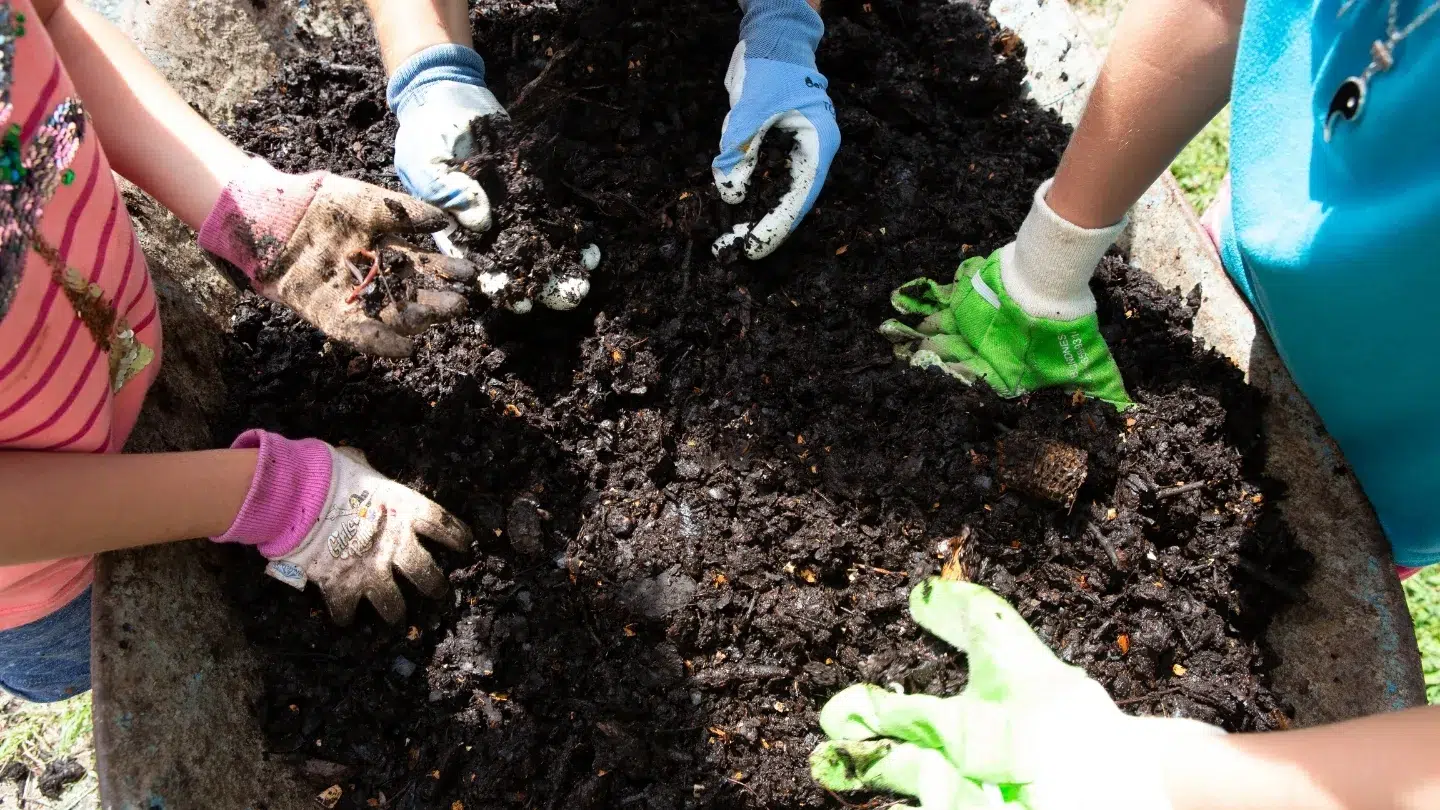
In early childhood education, taking fruit scraps from snack time to the compost bin is the first contact with the idea that organic waste is a resource.
The 8 steps to implement an environmental education program in a school
This is the approach used by leading international programs (Ecoescuelas, FEE, Escoles Verdes) and the one we recommend in our training sessions.
Steps 1 to 4: diagnosis, committee, objectives and action plan
Step 1: Environmental diagnosis or eco-audit. Before deciding anything, measure. Weigh a week’s worth of waste by fraction and by space (classrooms, playground, canteen and staff room), review the water and electricity bills for the last few school years, count single-use lunch packaging, and take stock of green areas. Without a baseline there is no demonstrable improvement, only good intentions. The diagnosis can be carried out jointly by students and companies like ours. This way, students start learning as soon as they start measuring.
Step 2: Creating the environmental committee. This is the program’s driving body and must be representative, not decorative: students from different levels (elected, not just for show), teachers from various subject areas, a member of the leadership team, families, and cleaning, kitchen and caretaking staff, who are the ones who truly know the school’s waste and consumption flows. Monthly meetings, brief minutes and recorded decisions.

If recycling is discussed in class, the school also has to separate its waste: curriculum and management have to go hand in hand.
Step 3: Measurable objectives. Turn the diagnosis into objectives with a number and a date. For example, “raising awareness about waste” is not an objective: reducing single-use lunch packaging by 40% before March is. Choose only a few: three objectives fully met are worth more than ten half-met.
Step 4: Action plan. For each objective: concrete actions, a named person responsible, a timeline, the resources needed, and a success indicator. Order the actions by impact-to-effort ratio and start with a quick, visible win — a plastic-free lunch is often one — because that first tangible success is what sustains staff motivation for the rest of the school year.
Step 5: Curricular integration. This is the step that separates an educational program from a clean-up campaign. Every action in the plan must connect to real competencies and assessment criteria: weighing waste is statistics and measurement in Maths; composting is decomposition in Natural Science; the communication campaign is persuasive writing in Language; the garden is geometry, biology and technology.
Step 6: Family involvement. Without families, the school’s work unravels at home every afternoon. It works better to ask for concrete, measurable actions. For example: that Wednesday’s lunch comes in a reusable container. Involve the parents’ association from the design stage, not just at implementation.
Step 7: Monitoring and evaluation. Measure the same indicators from step 1 again, using the same method. Publish the results even if they’re poor: an unmet objective that is explained teaches more than a polished success. Review the plan mid-year, not only in June.
Step 8: Communication. On the school’s website, on its social media, on a results board at the entrance written by the students themselves. Communication isn’t self-promotion: it’s what cements the program as part of the school’s identity and attracts support from the town council and local organizations.
| # | Step | What to do (the essentials) | Who leads it | When | Deliverable / indicator |
|---|---|---|---|---|---|
| 1 | Diagnosis or eco-audit | Weigh waste by fraction and space, review 2 years of water and electricity bills, count lunch packaging, inventory green areas | Students, with teacher support | September – November | Baseline report with quantified data |
| 2 | Environmental committee | Set up the driving body: students from various levels, teachers from various subjects, leadership team, families and kitchen, cleaning and caretaking staff | Leadership team | September | Founding minutes and monthly meeting schedule |
| 3 | Measurable objectives | Turn the diagnosis into objectives with a figure and a date. Maximum three | Environmental committee | October | 3 objectives with an indicator, starting value and target |
| 4 | Action plan | Actions, named person responsible, timeline, resources and indicator. Order by impact/effort and start with a quick win | Environmental committee | October – November | Action plan approved by staff |
| 5 | Curricular integration | Connect each action to real competencies and assessment criteria and put it in writing | Pedagogical coordination | November | Updated lesson plans |
| 6 | Family involvement | Ask for concrete, measurable actions at home; involve the parents' association from the design stage | Committee + parents' association | All year | % of families taking part in challenges |
| 7 | Monitoring and evaluation | Repeat the step-1 measurements using the same method; review the plan mid-year | Environmental committee | January (review) and May (close) | Before/after comparison by indicator |
| 8 | Communication | Website, social media, local press, results board at the entrance, and a code of conduct written by the students | Committee + leadership | June and ongoing | Public report and visible code of conduct |
Environmental education activities by stage: early years, primary and secondary
The same subject matter is covered at every stage: what changes is the mental operation asked of the students. Designing activities without adjusting for that level is the most common reason a session doesn’t work.
Early years and primary: from sensory bonding to systems thinking
Early childhood education (0-6 years): the goal is emotional bonding and habits. At this age, climate change isn’t explained: children build the attachment to their surroundings that will later support any environmental decision.
· Environmental storytelling about the 3Rs, with characters and repetition.
· Table of pouring and natural materials: leaves, pine cones, stones, water and soil.
· Caring for a living thing: one plant per child, with weekly watering and observation.
· The compost corner: bringing in fruit scraps from snack time and observing the change.
· Sorting by colour: waste sorting as a motor-skills game.

A litter-picking outing in nature is a concrete, low-cost way to involve families in the school’s environmental project.
Primary education (6-12 years): the goal is to understand the causes and act accordingly. This is where measurement and research come in.
· Playground eco-audit: collecting, sorting and weighing waste (Maths + Science).
· School garden with planting, watering and harvesting, including zero-waste cooking
· School composting with temperature and humidity logs.
· Upcycling workshop: turning the school’s waste into classroom materials and/or games.
· Neighbourhood map: local shops, bulk stores, recycling points and trees.
· Zero-waste family challenge for a month, for example using the Go Zero Waste app 😉
Secondary education (12-18 years), where the goal is critical analysis, data and community action. This is the stage where schools fail most often, because students are offered activities that feel too childish for them. What engages this age group is responsibility and complexity.
· A full waste audit of the school, with a technical report and proposals for the leadership team and the town council.
· Calculating the school’s carbon footprint: energy, transport, canteen, paper.
· The Climate Fresk and the Biodiversity Fresk: team-based causal-thinking activities.
· Life-cycle analysis of an everyday product (a phone, a T-shirt, a bottle).
· Role-play debates on a real local environmental conflict, backed by data.
· Service-Learning: final-year secondary students design and deliver environmental training for younger children. Teaching is the best way to learn.
· Second-hand swap markets organized entirely by the students
· Litter-picking in nature: an activity that generates real impact while teaching students about a natural environment.
How to turn your school into a zero-waste school
Of all the environmental areas, waste is the best entry point: it’s visible, it’s measurable in kilos, it produces results within weeks, and students can act on it directly. A zero-waste school isn’t one that recycles a lot, but one that has stopped generating waste in the first place — under the European hierarchy, prevention ranks above recycling.
Lunch and the playground: the two areas with the biggest immediate impact
The mid-morning snack is a school’s biggest source of waste, and at the same time the easiest to eliminate: aluminium foil, cling film, cartons, plastic bags and individual wrappers, multiplied by the number of students and by 175 school days.
Measures in order of impact:
- Mandatory reusable lunch boxes and bottles as part of the school’s project (not just a recommendation).
- Loose fruit on a fixed day each week, from a local supplier.
- Eliminating aluminium foil and cling film, replaced with wax wraps or cloth.
- Working, accessible water fountains, to cut out drink containers.
- Banning single-serve juice and dairy cartons on site.
- Segregated playground bins, labelled with pictograms designed by the students.
- Weekly weighing with a public chart at the school entrance.

Reusable lunch box and bottle: the highest-impact measure for eliminating school lunch waste.
The canteen and composting: closing the organic matter loop
The school canteen is the second focus, and the most uncomfortable one. Studies available in Spain put food waste at between 82 and 128 grams per diner per meal, around 22% of the meal served.
What works:
· Measuring by plate and by day to identify which recipes get rejected and why (taste, texture, presentation, time in the menu cycle).
· Adjustable portions: allowing small portions with the option to have more, instead of uniform servings.
· Reducing canteen noise: there’s evidence of a correlation between noise levels and waste.
· On-site composting: of the organic fraction, with the compost going to the school garden. This closes the loop and makes it visible: Thursday’s waste feeds June’s tomatoes.
Common mistakes when implementing an environmental education program, and how to avoid them
We’ve spent more than six years working with schools, and the programs that fail almost always fail for the same reasons. None of them have anything to do with a lack of budget.
The five mistakes that make programs fail
- Relying on a single person. The environmental teacher retires, transfers, or burns out, and the program disappears with them. Solution: an environmental committee with at least four teachers from different subject areas, a member of the leadership team, and the program written into the school’s educational plan, not left in a drawer.
- Starting without measuring. Without a baseline, it’s impossible to demonstrate improvement, and without demonstrable improvement, staff lose interest by the second year. Solution: dedicate the entire first term to the diagnosis, and have the students carry it out.
- Activities with no curricular link. If environmental education lives outside timetabled hours, it competes with everything else — and loses. Solution: tie every action in the plan to assessment criteria written into the lesson planning.

In secondary school, what engages students is responsibility and complexity: data, debate and real proposals.
4. Inconsistency between what’s said and how things are managed. Teaching circular economy in a school that serves drinks in single-use bottles undermines the credibility of the message better than any counter-argument could. Solution: audit the school first, then teach.
5. Treating students as an audience, not as protagonists. A program designed entirely by adults produces spectators. Solution: give the student committee real decisions: budget, plan priorities, campaign design — not just carrying out what’s already been decided.
How to keep the program going beyond the first year
A program’s survival from one year to the next depends on four simple mechanisms:
· Document everything: committee minutes, diagnostic data and the plan in a shared, accessible folder — not on one person’s computer.
· Generational handover among students: each year, the outgoing committee trains the incoming one. If possible, leave a written handover or a guide.
· A fixed annual calendar: September diagnosis, October plan, January mid-year review, May evaluation, June report and public summary.
· Training for staff, not just students: if new teachers don’t get an induction session on the program, it fades out within two years. It is, by far, the investment with the best return in the whole process.
- What is a school environmental education program?
It’s a structured, evaluable project that integrates sustainability across three dimensions of the school: the curriculum (what is learned), management (waste, water, energy, canteen, playground) and the community (families, the town council, the surroundings). It takes the form of a document with an environmental diagnosis, measurable objectives, an action plan, monitoring indicators and a communication plan, and it includes an environmental committee with representation from students, teachers, families and non-teaching staff. It’s distinguished from a one-off activity by two features: continuity over time and measurement of results.
- What are the objectives of environmental education in schools?
They fall into three levels. Cognitive: understanding global and local environmental challenges — the climate crisis, biodiversity loss, pollution, the linear economy — and their causes. Socio-emotional: developing a bond with one’s surroundings, shared responsibility, critical thinking and the ability to work collectively. Behavioural: adopting verifiable sustainable habits and taking action to genuinely improve one’s surroundings. Under the LOMLOE framework, these objectives align with education for sustainable development and global citizenship, and with SDGs 4, 11, 12 and 13. A common mistake is stopping at the cognitive level: UNESCO research shows that 67% of countries address climate change only through cognitive learning, and only 7% through the socio-emotional dimension.
- How can families be involved in an environmental project?
With concrete, measurable requests that are low-cost to start with, not generic talks. What works: setting one weekly packaging-free lunch day; launching a month-long family challenge tracked at home; organizing second-hand swap markets run by students; holding environmental family days; and involving the parents’ association from the plan’s design stage, not only at implementation. The key is consistency between home and school: if the school eliminates cling film but it’s still used at home, students notice the contradiction and the habit doesn’t stick. Communicating measured results — “we’ve cut 18 kg of waste a month” — is what most boosts participation in the second year.


- How do you measure the results of an environmental education project?
With indicators set before starting and always measured using the same method. Environmental: kg of waste by fraction and by space, m³ of water, kWh of electricity, grams of food waste per diner in the canteen, kg of compost produced, number of trees or m² of re-naturalized land. Participation: percentage of students involved in actions, number of families responding to challenges, hours of staff training. Pedagogical: curricular assessment criteria addressed through the program and evaluation of associated competencies. The indispensable requirement is the baseline from the initial diagnosis: without it, there’s no possible comparison. Publishing the results, including objectives that weren’t met, is part of the method.
- How much does an environmental education program for schools cost?
The cost depends on three variables: duration, number of students and the activities included. A substantial part of the program — diagnosis, environmental committee, action plan, curricular integration, monitoring — has zero material cost and is carried out with the school’s own resources; what’s typically contracted out is teacher training, methodological support and specialized activities (workshops, audits, activities like the Climate Fresk, storytelling, field trips). At Go Zero Waste we work with a fixed price per training, set according to those three variables, and we provide the materials needed. We recommend starting with a modest investment in staff training: it’s the expense with the best return, because it’s what makes the program survive its first year.
Summary and conclusions
Implementing an environmental education program in a school means moving from isolated activities to a structured project that integrates the curriculum, school management and the community. The process follows eight steps: environmental diagnosis, environmental committee, measurable objectives, action plan, curricular integration, family involvement, monitoring and communication — practically the same seven steps as the international Ecoescuelas standard.
The LOMLOE doesn’t require a program under that specific name, but it does make education for the ecological transition and sustainable development mandatory, cross-curricular content (articles 1.r, 14.3, 18.3, 110.3 and 121), which makes the program format the most effective route to verifiable compliance. Activities should be adapted to the stage: sensory bonding and habits in early years, measurement and research in primary, data, debate and Service-Learning in secondary.
The area of waste is the best entry point thanks to its visibility and measurability, with two priority areas — lunch and the canteen, where between 82 and 128 grams per diner per meal go to waste — and composting as a way of closing the loop. Joining networks like Ecoescuelas or Escoles Verdes provides methodology, guidance and recognition that give the project continuity. And programs that fail almost always do so for five avoidable reasons: relying on one person, not measuring, not linking to the curriculum, being inconsistent in management, and treating students as an audience.
✅ Without an initial diagnosis there is no program, only activities. The baseline is the one truly indispensable requirement: it’s what turns good intentions into demonstrable improvement.
✅ Curricular integration is the line between an educational project and a clean-up campaign. Whatever isn’t written into the lesson planning competes with everything else — and ends up losing.
✅ Consistency in management teaches more than content does. A school that explains the circular economy while serving water in single-use bottles is, in practice, sending the opposite message.
✅ Budget isn’t the limiting factor; structure is. The highest-impact steps — committee, diagnosis, objectives, curricular integration — have zero material cost. What costs money, and is worth it, is staff training.
✅ A program survives if it’s part of the school’s educational plan, not one person’s personal agenda. Shared documentation, a trained student handover, a fixed annual calendar and induction for new teachers: that’s what gets a program to its third year.
Bibliography
- Organic Law 3/2020, of 29 December (LOMLOE), amending Organic Law 2/2006 on Education. Consolidated text: https://www.boe.es/buscar/act.php?id=BOE-A-2006-7899
- UNESCO (2021). Getting every school climate-ready: how countries are integrating climate change issues in education. https://unesdoc.unesco.org/ark:/48223/pf0000379591
- UNESCO (2024). Greening curriculum guidance: teaching and learning for climate action. https://www.unesco.org/en/articles/qa-why-greening-education-long-term-solution-our-planet
- UNESCO (2026). Quality standard for green schools and the Alliance for Green Education. https://www.unesco.org/es/articles/mas-de-110-000-centros-educativos-se-han-adherido-la-norma-de-calidad-para-escuelas-verdes-de-la
- ADEAC – Association for Environmental and Consumer Education. Ecoescuelas Programme: the seven-step methodology and the Green Flag. https://www.miteco.gob.es/es/ceneam/recursos/quien-es-quien/adeac.html
- Government of Catalonia. Escoles Verdes Programme and the Catalonia Network of Schools for Sustainability (XESC). https://xtec.gencat.cat/ca/projectes/escoles-verdes/ · https://mediambient.gencat.cat/es/05_ambits_dactuacio/persones-i-natura/centres-educatius/xarxa-escoles-verdes/centres/
- Spanish Ministry of Education, Vocational Training and Sport (2024). Recognition for sustainable schools: the whole-school approach to sustainability and global citizenship. https://www.miteco.gob.es/es/ceneam/recursos/materiales/-reconocimiento-a-centros-educativos-sostenibles.html
- Justicia Alimentaria. Escoles que Aprofiten project: food waste in school canteens. https://justiciaalimentaria.org/desperdicio-alimentario/
- FUHEM / CENEAM. Understanding and protecting the natural environment under the LOMLOE. https://www.miteco.gob.es/en/ceneam/recursos/materiales/conocimiento-defensa-medio-natural-lomloe.html
- Teachers for Future Spain. The LOMLOE from an environmental perspective. https://teachersforfuturespain.org/la-lomloe-en-clave-ambiental/
💡 We train your staff and students so the program works from year one
We’ve spent more than six years working with schools on their journey toward sustainability: more than 35 schools trained and over 5,000 hours of training delivered, from early years centres to universities such as the UAB, the Politecnico di Torino and Ritsumeikan University.
We design the activities together with your school, tailored to the age group, education level and your pedagogical goals: zero waste and circular economy, school gardens, community composting, the SDGs, upcycling workshops, swap markets, environmental storytelling and specific training for teaching staff. We bring all the materials, in person or online, and in many municipalities the training can be subsidized through the town council, provincial council or county council.

Environmental consultant and impact entrepreneur, based in Barcelona and specialized in sustainability, zero waste and the circular economy.
- Corporate sustainability
- Circular economy
- Environmental education
- Zero waste projects
- ESG & CSRD reports
You might also be interested in:
Activity ideas for World Environment Day
World Environment Day is held every 5 June. Here are nine activity ideas —beach clean-ups, swap markets and sustainability training— to help companies, schools and local councils move from awareness…

What is a zero-waste lifestyle?
Zero Waste is a movement that seeks to minimize our environmental footprint, not only by recycling, but by preventing waste from being generated in the first place. It is based…
How to reduce waste at school?
Discover how to reduce waste in an educational setting, whether it's a preschool, primary school, secondary school, or university. Improve sustainability in schools with practical case studies and our suggestions.