
- Blog
- How to make an urban garden
How to make an urban garden
- 05/11/2026
- Magda Cebrián
Creating an urban garden involves choosing a space with at least 4-6 hours of sunlight, preparing well-draining containers, filling them with compost-rich substrate, and planting seasonal vegetables with regular watering. It’s one of the simplest ways to bring the circular economy to the city: it transforms organic waste into compost, reduces food packaging and travel distances, and reclaims underutilized spaces. It works equally well on a balcony, a company rooftop, a school playground, or a municipal lot.
In the European Union, approximately 129 kg of food waste was generated per capita in 2024, and more than half of it came from households.
Source: Eurostat, 2025
Browse through the publication
What is an urban garden?
An urban garden is a space within the city for growing vegetables, herbs, and fruits: a balcony, a terrace, a rooftop, a schoolyard, or a municipal lot.
From a zero-waste perspective, it also functions as an open-air classroom: someone who has cared for a lettuce for two months is unlikely to let it spoil in the refrigerator. That’s why it’s such an effective tool against food waste.
Benefits of an urban garden
Environmental benefits
- Close the organic matter cycle: home or community composting transforms kitchen scraps into fertilizer and prevents them from ending up in the general waste bin.
- Less packaging and fewer kilometers: what is harvested on the balcony or roof does not need a plastic tray or a cold chain.
- More urban biodiversity: flowers and aromatic plants attract pollinators and beneficial fauna.
- Water used wisely: drip irrigation and mulching reduce consumption. In hydroponic cultivation , the urban microgreen farm we work with in Barcelona uses up to 90% less water than traditional agriculture.
Economic benefits
- Savings on vegetables and herbs: which are the most expensive per kilo and the most wasted.
- Reused material: fruit boxes, pallets and jugs can be turned into containers.
Drip irrigation avoids the two typical mistakes: forgetting to water and overwatering.
Social benefits
- Health and well-being: working with your hands in the soil reduces stress and encourages physical activity.
- Community: In Madrid, more than 1,700 people participated in the municipal Community Urban Gardens Network .
- Food security on a global scale: The FAO estimates that some 800 million people practice urban and peri-urban agriculture worldwide.
Examples of urban gardens around the world
Xarxa d'Horts Urbans - Barcelona
Since 1997, Barcelona has been promoting a municipal network of organic allotments for people over 65, run by a non-profit organization. Today, it has 15 municipal urban allotments spread across the city’s 10 districts.
Community Urban Garden Network - Madrid
In 2014, the Madrid City Council created the Municipal Program of Community Urban Gardens in conjunction with the neighborhood garden network: the municipality provides and prepares plots of land, and the associations manage them themselves. The network grew from 17 to more than 50 community gardens in less than ten years, with over 1,700 participants, and 174 schools had school gardens within the municipal network.
Urban Nature - Paris
Above pavilion 6 at Paris Expo Porte de Versailles operates the largest rooftop urban farm in Europe: 14,000 m2. It produces around 200 kg of fruit and vegetables a day for nearby restaurants and hotels and reuses city resources such as empty spaces and organic waste.
Nature Urbaine cultivates 14,000 m² on pavilion 6 of Paris Expo Porte de Versailles.
How to make an urban garden step by step
Before we begin, here are the seven basic steps to create an urban garden at home, on the balcony, or on the terrace:
- Observe the sun: Fruiting vegetables (such as tomatoes or peppers) need 6 hours of direct sunlight, leafy vegetables and aromatic plants are fine with 3-4.
- Check the weight capacity of the space: Wet substrate is very heavy: a 100x40x30 cm (120 liter) planter can exceed 100 kg. For rooftops and balconies, consult with the building management or a technician.
- Choose containers with drainage: planters, raised beds, raised garden beds, or vertical gardens. Minimum depth: 15-20 cm for lettuce and radishes, 30-40 cm for tomatoes and zucchini.
- Prepare the soil: Mix quality peat-free substrate with 20-30% compost or worm castings and put a drainage layer (gravel or expanded clay) at the bottom.
- Plan what to plant and where: with 30×30 cm grids and crop associations.
- Install irrigation: A drip irrigation system with a timer or pots with a water reservoir prevents the two typical mistakes: forgetting to water and overwatering.
- Compost and mulch: Kitchen scraps return to the urban garden as fertilizer, and a layer of straw or pruning waste retains moisture.
The loofah is eaten when young and, once dried, becomes a natural and compostable sponge.
What to plant in an urban garden
We show you in a table what to plant according to the season and its difficulty:
|
Season
|
What to plant
|
Difficulty
|
|
|---|---|---|---|
|
Autumn
|
Lettuce, spinach, chard, radishes, garlic, broad beans, peas
|
Low
|
|
|
Winter
|
Garlic, onions, broad beans, cabbage in temperate zones
|
Low-Medium
|
|
|
Spring
|
Tomatoes, peppers, zucchini, beans, strawberries, basil
|
Medium
|
|
|
Summer
|
Summer lettuces in the shade, cucumbers, eggplants, herbs
|
Medium
|
|
|
All year
|
Parsley, chives, mint, rosemary, thyme, microgreens
|
Very low
|
If you start now, in autumn, lettuce, radishes, and broad beans are the safest bet. The dates vary depending on the climate of each area: inland and in mountainous regions, delay spring sowing by a few weeks.
Common mistakes
Here is a list of common mistakes made when starting an urban garden:
- Planting out of season: a tomato in November will not thrive
- Drainage or shallow containers: the roots rot or fail to develop.
- Overwatering or irregular watering, especially in summer and during holidays
- Not planning who will take care of it: in companies and schools, the garden dies in August if no one has a shift.
- Using unfertilized garden soil or chemical fertilizers breaks the circular approach
- Ignoring the weight on balconies and rooftops
Composting turns kitchen scraps into fertilizer and prevents them from ending up in the general waste bin.
- What do you need to create an urban garden?
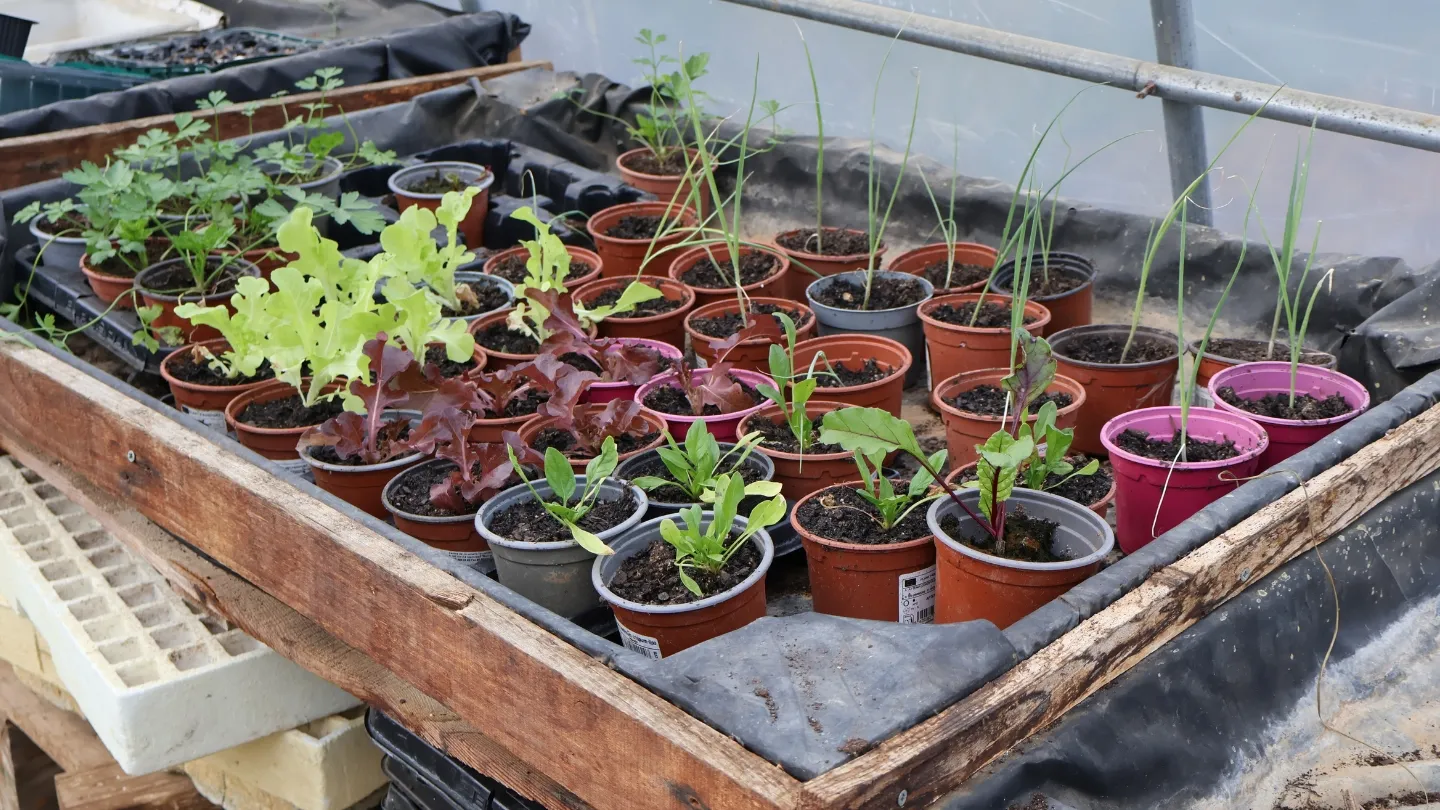
To get started, you’ll need a spot with at least four hours of sunlight, containers with drainage holes, quality potting mix combined with compost, seasonal seeds or seedlings, and a simple watering system. With two 30-40 cm deep planters and a few hand tools, you can already harvest lettuce, radishes, and herbs.
- What is the easiest thing to plant in an urban garden?
The easiest vegetables to grow are lettuce, radishes, spinach, chard, and herbs like parsley, mint, or rosemary. They grow quickly, tolerate some shade, and are forgiving of minor watering mistakes. Radishes are ready to harvest in about four weeks, making them ideal for starting with children or in the office.
- How many hours of sunlight does an urban garden need?
Fruiting vegetables, such as tomatoes, peppers, and zucchini, need about six hours of direct sunlight per day. Leafy greens and most herbs thrive with three or four hours. If your balcony doesn’t get much light, opt for lettuce, spinach, mint, or microgreens grown indoors.
- How deep should an urban garden be?
It depends on the crop. For lettuce, radishes, and herbs, 15 to 20 centimeters of substrate are sufficient. Tomatoes, peppers, eggplants, and zucchini need at least 30 to 40 centimeters to develop their roots properly. A raised bed or urban garden makes the work easier and eliminates the need to bend over.
- How much does it cost to create an urban garden?
A small balcony garden can be set up for under €100 if you reuse boxes or jugs as containers. Wooden raised beds or commercial kits cost more, and recurring expenses are low: potting mix, seeds, and water. Homemade compost further reduces fertilizer costs.
- What to plant now in an urban garden in autumn?
Autumn is a great time to plant lettuce, spinach, chard, radishes, garlic, broad beans, and peas. These crops tolerate moderate cold and thrive with the season’s rains. In inland or mountainous areas, protect them from frost with thermal netting or plant them against a south-facing wall.
Summary
Learning how to create an urban garden is easier than it seems: sun, good soil, containers with drainage, and seasonal crops. The important thing is to start with a small garden and close the cycle with compost. At home, in the office, at school, or in the community, every garden transforms waste into resources and reconnects us with what we eat. Shall we plant the first seed?
💡 Do you want to start an urban garden in your company or municipality?
With our urban gardening workshop, your team learns to design a garden in a small space, plants seasonal seedlings, and takes a plant home.
Bibliography
- Eurostat (2025). Food waste and food waste prevention – estimates .
- Official State Gazette (BOE). Law 7/2022, of April 8, on waste and contaminated soils for a circular economy .
- MITECO. Draft order for exemption from authorization for domestic, community and agricultural composting .
- FAO (2001). Urban and peri-urban agriculture: a briefing guide .
- Barcelona City Council (2025). Xarxa d’Horts Urbans Municipals – call 2025 .
- Barcelona City Council (2019). Barcelona consolidates a group of page markets .
- UOC (2018). Sowing life in the cities: urban horts of Barcelona .
- Madrid City Council. Urban gardens, spaces to rediscover healthy eating and Madrid, a benchmark for urban agroecology .
- Viparis. Nature Urbaine .
- Time Out Paris (2020). The largest urban ferme in today’s world .
- United Nations. Sustainable Development Goals .
Environmental consultant and impact entrepreneur, based in Barcelona and specializing in sustainability, zero waste and circular economy.
- Sostenibilidad corporativa
- Economía circular
- Educación ambiental
- Proyectos residuo cero
- Informes ESG & CSRD
You may also be interested in:
Six fun team building activities
Blog 06/29/2026 Magda Cebrián Team building is no longer what it used to be. Today’s most forward-thinking companies are investing in experiences that combine team cohesion, a genuine purpose, and…
Examples of sustainable activities that generate a large impact
Today we highlight key actions to promote sustainability and the circular economy. These include the transition to renewable energy, bulk and local consumption, and waste prevention. These initiatives not only…
Interview with AbonoKm0
We visited AbonoKm0, an association dedicated to transforming organic waste into valuable resources, promoting sustainable practices at both the household and business levels.